

Table of Contents
- What Makes Expensive Spiritual Tools Different
- Affordable Spiritual Tools That Support Real Practice
- Spiritual Tools for Beginners: Starting Without Breaking the Bank
- How to Choose a Meditation Cushion for Your Practice
- Meditation Tools for Home Practice: Building Your Sacred Space
- Price vs. Value: What Actually Determines Worth
- Making Your Choice: Budget, Intention, and Long-Term Use
- Frequently Asked Questions
Last Updated: October 18, 2026
What Makes Expensive Spiritual Tools Different
Spiritual tool prices vary wildly, a basic meditation cushion might cost $40, while a premium crystal singing bowl set runs nearly $400. The difference isn't always quality; it's often materials, craftsmanship, and intention.
Expensive spiritual tools typically feature higher-quality materials. An organic buckwheat-hull cushion in organic cotton costs more than synthetic alternatives but adapts to your body and lasts longer. Crystal singing bowls handmade from quartz and tuned to 432Hz command higher prices because each is individually hammered for precise tuning.

The real question isn't whether expensive tools are inherently better, but whether the cost aligns with your actual practice. Someone meditating five minutes daily doesn't need the same investment as someone sitting for an hour, intention matters far more than price.
Affordable Spiritual Tools That Support Real Practice
You don't need to spend hundreds to build a meaningful spiritual practice. Affordable tools work just as well when chosen intentionally and used consistently.
A basic meditation cushion at $37.90 provides the same postural support as premium versions, what matters is keeping your spine aligned so you focus on your breath rather than your knees. Candles, incense, and simple altar items cost a few dollars but create the atmosphere that helps you settle into practice.

The real cost of building a practice isn't the individual items; it's consistency. A $40 cushion used daily for two years costs pennies per use, while a $400 singing bowl gathering dust is wasted money no matter how premium the materials.
| Tool | Price | Best For | Key Benefit |
|---|---|---|---|
| Meditation Cushion | $37.90 | Daily sitting practice | Ergonomic support |
| Morning Ritual Bundle | $62.08 | Starting a routine | Complete morning setup |
| Yoga Mat | $79.97 | Movement practice | Non-slip, eco-friendly |
| Mala Necklace | $195.00 | Wearable reminder | Portable spiritual anchor |
| Crystal Singing Bowls | $389.99 | Sound healing | Immersive acoustic experience |
Spiritual Tools for Beginners: Starting Without Breaking the Bank
"Start small" doesn't tell you what to do in a shop. A clearer framework: sort every potential purchase into one of four actions, buy, borrow, make, or skip.
Buy: when the tool removes a real obstacle
Buy when a tool solves a specific, recurring problem. If knee or hip discomfort stops you sitting after ten minutes, a supportive cushion is functional, not luxury. If a chaotic space keeps you from focusing, a candle or incense routine can be worth a few dollars. The test: can you name the obstacle the tool removes? If yes, buy at the level that solves it, often the affordable option does.
Borrow: when you're still testing the practice
Borrow before you buy anything you're unsure about. Many yoga studios, meditation centers, and libraries lend cushions, bolsters, and sometimes singing bowls. A friend's mala can tell you in a week whether a tool fits your routine, preventing the most common beginner mistake: buying a premium item for an untested practice.
Make: when the tool is simple enough to create
Some of the most meaningful tools are the easiest to make yourself. A candle, altar cloth, intention cards, or journal can be assembled for very little and often carries more personal meaning than a purchased equivalent. Reserve DIY for simple items, don't try to hand-tune a crystal bowl, and put the savings toward one well-chosen anchor tool.
Skip: when the tool is decoration or a shortcut
Skip any tool you can't connect to a specific practice habit. A beautiful crystal you'll display but never work with, a second oracle deck when the first is still unfamiliar, or a premium bundle bought to feel "serious" about a practice you haven't started, these gather dust. Skipping keeps your space and budget focused on tools you'll actually touch.
A starter path that costs under $100
If you want a concrete sequence, try this:
- Week one: borrow or use a firm pillow at home to test whether seated practice is comfortable. No purchase.
- Week two: if sitting is the obstacle, buy one supportive cushion, the Organic Buckwheat Meditation Cushion at $37.90 is adjustable and washable, so it grows with you.
- Week three: add one atmosphere item, such as a candle or incense, only if you've actually sat consistently.
- Month two: if you want a wearable reminder, consider a mala, but only after you know you'll wear it daily. The Calm Shores Mala Necklace at $195.00 is a premium step, not a starting point.
- Month three and beyond: invest in specialized tools like a singing bowl set only when a specific practice (sound meditation, for example) has become a regular part of your week.
Many beginners worry cheaper tools won't support their growth. The truth is simpler: your commitment matters more than the price, and the buy-borrow-make-skip framework keeps your spending aligned with the commitment you actually have, not the one you hope to have.

How to Choose a Meditation Cushion for Your Practice
A meditation cushion is one of the first tools beginners consider, and choosing wisely makes a real difference in how long you can sit comfortably.
Look for a cushion filled with natural materials like buckwheat hulls, which conform to your body shape and provide consistent firmness; synthetic foam compresses over time, losing support.
Height and firmness are personal, some prefer a higher cushion for deeper hip elevation, others something flatter.
Consider whether you'll use the cushion daily. If you're committed to a regular practice, a quality cushion makes sense; if you're still exploring, a basic lower-priced cushion lets you test the practice before upgrading.
Meditation Tools for Home Practice: Building Your Sacred Space
A dedicated meditation space transforms your practice from something squeezed between tasks into a ritual that invites deeper focus. It doesn't need to be large or elaborate, just intentional.
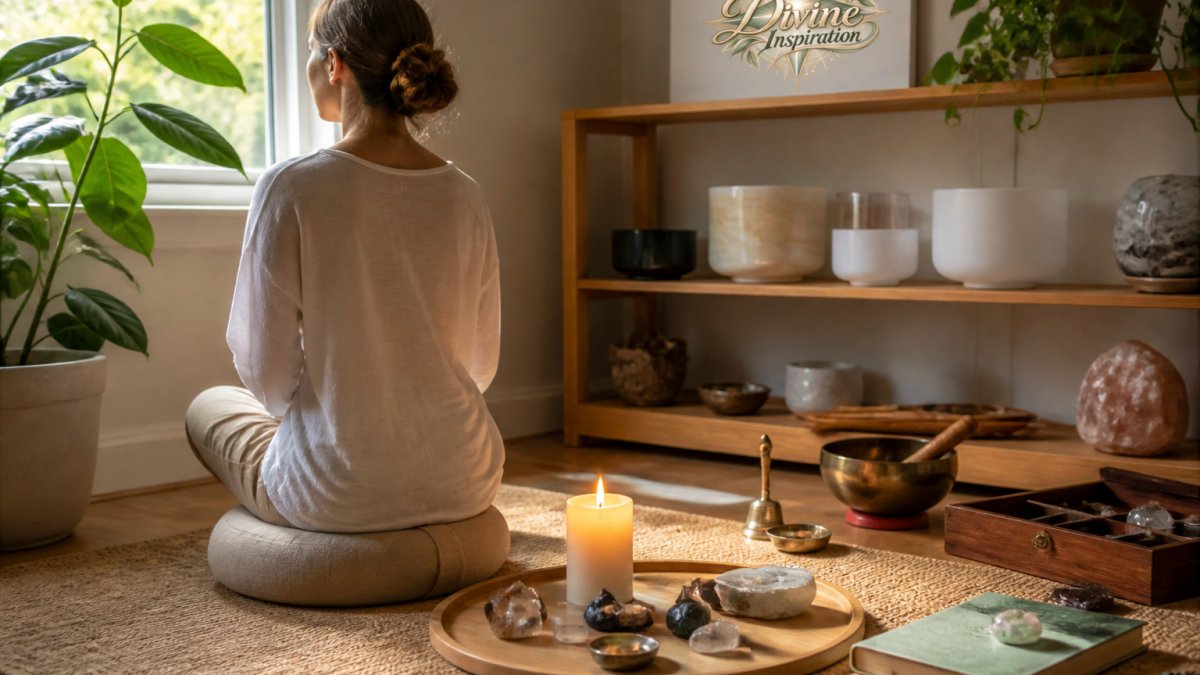
Start with a few core elements: a cushion to sit on, a candle or incense to mark the beginning of practice, and optionally a mala or other grounding object. The Morning Ritual Bundle for Mindfulness at $62.08 gives you a mug, a journal, and a candle, simple items that signal to your mind and body that you're entering sacred time.
If you're drawn to sound healing, the CVNC Crystal Singing Bowls Set at $389.99 includes seven bowls ranging from 6 to 12 inches, mallets, and carry cases.
Transform Your Sound Journey with the CVNC Crystal Singing Bowls Set →
The Eco-Friendly Cork Yoga Mat at $79.97 works well if your practice includes movement or stretching. Cork provides natural grip and cushioning, and sustainable materials align with the values many spiritual practitioners hold.
Your space should reflect your personal beliefs and aesthetic. This is where Divine Inspiration's curated collection helps. We've selected tools designed as physical expressions of shared beliefs, inviting you to discover personal transformation and meaning.
Price vs. Value: What Actually Determines Worth
Most articles stop at "expensive doesn't always mean better." True, but that doesn't help at the register.
1. Materials and construction. This is the most defensible premium. An organic buckwheat-hull cushion with a removable, washable organic cotton cover holds its shape longer than synthetic foam that compresses within months.
2. Craftsmanship and labor. Hand-hammered bowls, hand-knotted malas, and small-batch candles cost more because of time and skill, not spiritual superiority.
3. Curation and branding. Some of the gap between a $40 and a $120 cushion is presentation, packaging, and brand positioning.
4. Claims you can't verify. Be cautious with tools marketed on guaranteed healing, measurable energy effects, or specific health outcomes.
A simple cost-per-use test
The fastest way to judge worth: divide the price by the number of times you realistically expect to use the tool in a year.
- A $37.90 cushion used five days a week is roughly 260 uses a year, well under $1 per session in year one, and less every year after.
- A $195.00 mala worn daily is also under $1 per day in year one, and keeps paying back as long as you wear it.
- A $389.99 singing bowl set used twice a month is about 24 uses a year, roughly $16 per session in year one. That can still be worth it for someone committed to sound practice, but it's a very different calculation from daily use.
Run that math before you buy. If the per-use number makes you wince, the tool probably isn't the right fit yet, not because it's bad, but because your practice hasn't caught up to the price.
Questions to ask before paying a premium
- Does the upgrade change how the tool functions, or only how it looks? Materials and fit matter; finish and packaging usually don't.
- Can I name the specific feature I'm paying for? "Organic buckwheat filling," "removable washable cover," "hand-tuned to 432Hz" are concrete. "High-vibration" is not.
- What's the realistic replacement or maintenance cost? Candles and incense are consumables; a cushion or mala is a one-time purchase that should last years with basic care.
- Would I still want this at half the price? If the answer is no, you may be paying for the story rather than the tool.
Making Your Choice: Budget, Intention, and Long-Term Use
The decision between expensive and affordable spiritual tools comes down to three questions: What's your budget? What's your actual commitment level? Which tools will you realistically use?
If you're just starting, begin with one or two affordable items.
As your practice deepens, you can invest in premium items. The CVNC Crystal Singing Bowls at $389.99 make sense for someone committed to sound healing as a regular practice.
The real measure of worth isn't the price tag, it's whether the tool invites you back to your practice day after day.
At Divine Inspiration, we believe expensive spiritual tools are worth it when they genuinely support your journey toward personal transformation and deeper connection with the sacred presence within you.
Building a meaningful spiritual practice doesn't require spending hundreds on tools. At Divine Inspiration, we've curated meditation tools, mala necklaces, singing bowls, and ritual bundles designed to help you recognize the sacred presence within yourself.
Frequently Asked Questions
Are expensive spiritual tools actually more effective than affordable ones?
Effectiveness depends on intention and consistency, not price. A $38 meditation cushion works just as well as a $200 one if you use it regularly. What matters is choosing tools that fit your practice and personal beliefs. Expensive materials like high-quality crystals or hand-hammered singing bowls may offer durability and aesthetic appeal, but a budget option can support genuine spiritual growth if it resonates with you and encourages regular use.
What should I consider before buying expensive spiritual tools?
Before investing, ask: Will I use this regularly? Does it align with my spiritual practice? Can I afford it without financial stress? Quality matters for items you'll use daily (like a meditation cushion at $37.90 versus $200), but intention matters more than cost. Start with one affordable tool to test your commitment. The Organic Buckwheat Meditation Cushion at $37.90 is an entry point that doesn't require a large investment while you explore what tools support your practice.
Can affordable spiritual tools support a meaningful practice?
Yes. Meaningful practice comes from consistent use and genuine intention, not price tags. Many practitioners build deep spiritual awareness with inexpensive items: candles, journals, and simple cushions. The Morning Ritual Bundle at $62.08 combines three essential tools at an accessible price. What transforms a tool from decoration to practice support is how you use it, lighting a candle with intention, sitting on a cushion daily, or wearing a mala as a reminder to pause. Budget tools work when you commit to using them regularly.
How do I know if a spiritual tool is worth the money?
Evaluate tools by durability, how well they fit your space, and whether they encourage regular use. A $389.99 crystal singing bowl set is worth the investment if you practice sound healing consistently; a $79.97 yoga mat is worth it if you flow daily. Consider total cost of ownership: will this item last years or months? Does it serve multiple purposes? The Calm Shores Mala Necklace at $195 offers wearable daily practice support, while the meditation cushion at $37.90 is affordable enough to test before committing to premium options. Start small, use consistently, and upgrade only when you've outgrown what you have.
0 comments