

Table of Contents
- Quick Comparison: Meditation Tools at a Glance
- How to Start a Meditation Practice: Foundation First
- Meditation Cushion for Home Practice: Comfort Meets Posture
- Best Meditation Apps for Beginners: Digital Guidance
- Meditation Timer and Breathing Tools: Structuring Your Session
- Ambient Support: Candles, Incense, and Sound for Meditation
- Wearable and Jewelry Tools: Meditation Tools You Can Carry
- Conclusion: Building Your Beginner Meditation Toolkit
- Frequently Asked Questions
Last Updated: October 9, 2026
Quick Comparison: Meditation Tools at a Glance
Starting a meditation practice doesn't require expensive equipment. The best meditation tools for beginners range from simple cushions to guided apps, and at Divine Inspiration we've curated meditation tools for beginners for different needs and budgets.
| Tool Type | Best For | Starting Price | Key Benefit |
|---|---|---|---|
| Meditation Cushion | Home practice with proper posture | $37.90 | Comfort during longer sessions |
| Meditation Apps | Guided instruction and structure | Free to $15/month | Accessibility and flexibility |
| Meditation Candle | Ambient support and ritual | $58.00 | Sensory engagement and focus |
| Mala Necklace | Portable mindfulness practice | $195.00 | Wearable reminder and counting tool |
| Incense Sticks | Atmospheric enhancement | $14.95 | Aromatherapy and ritual |
| Crystal Singing Bowls | Sound-based meditation | $389.99 | Vibrational support and relaxation |
| Meditation Guide Book | Structured learning | $42.76 | In-depth teachings and techniques |
How to Start a Meditation Practice: Foundation First
Before investing in tools, understand what meditation requires: intention, a quiet space, and regular commitment. Tools support your practice; they don't replace the discipline of sitting down and focusing your mind.

Many beginners buy everything at once, hoping the right cushion or app will sustain their practice. Start simple: choose one tool, use it for two weeks, then add more if needed.
A practice works best when it fits your existing routine. Morning suits some, evening others; timing matters less than consistency. Your tools should make your chosen time easier, not harder.
Meditation Cushion for Home Practice: Comfort Meets Posture
Proper posture transforms meditation from uncomfortable to sustainable: spine upright, shoulders relaxed, hips slightly above your knees.
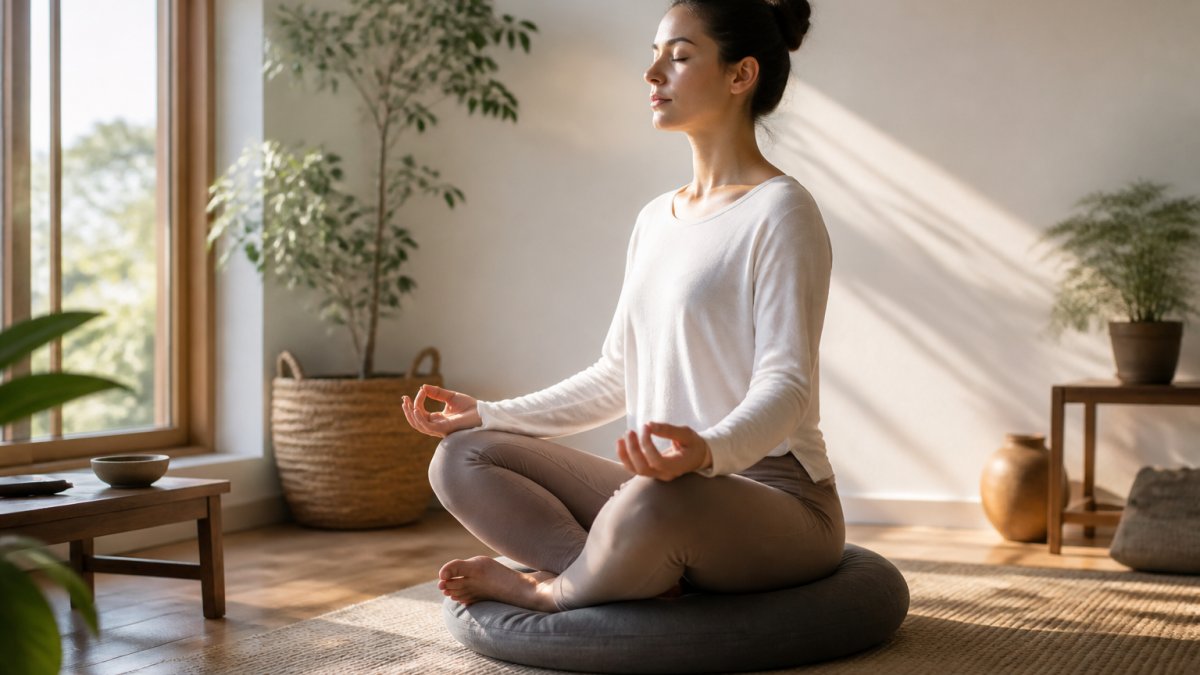
Elevated hips let your knees drop toward the floor, reducing lower back strain so you can sit longer.
The Organic Buckwheat Meditation Cushion has a removable, machine-washable organic cotton cover and buckwheat hull filling for personalized firmness. Designed for all levels, it costs $37.90.
What matters most in a cushion is height and firmness: too soft and you sink in, too low and you gain no postural benefit.
Best Meditation Apps for Beginners: Digital Guidance
Meditation apps provide structure, guidance, and accountability. A good app walks you through technique, offers varying session lengths, and offers free options to explore before committing financially.
What the major apps actually offer beginners
The app market splits into three tiers: fully free, freemium, and subscription-only.
- Insight Timer is the strongest free starting point, with a largely free library of guided sessions, ambient tracks, and live events. The trade-off is quality variance: with so many teachers, a session that clicks for one beginner may feel flat to another. Use ratings and preview clips before a 30-minute sit.
- Healthy Minds Program is free and built around a four-pillar curriculum (awareness, connection, insight, purpose). It suits those wanting course-like progression rather than a pick-any-session library.
- Headspace is the most beginner-friendly on-ramp, with polished production and short, clearly narrated sessions. It's subscription-based after a limited free trial, best for those who want guided instruction and will pay for it.
- Calm leans into sleep content, sleep stories, and ambient soundscapes alongside its meditation library. If your goal is winding down rather than formal practice, it fits; for technique instruction, it's less structured than Headspace.
- Ten Percent Happier skews skeptical, secular, and explanation-first. Sessions include brief context on why a technique works, suiting beginners who want reasoning, not just the voice.
- Balance builds a personalized program that adapts as you log sessions, helping beginners lost in a giant library. The trade-off: the adaptive path feels less transparent than a fixed curriculum.
Free versus paid: what you actually get
Most freemium apps give a rotating selection of guided meditations, usually 5-15 minutes. Paid tiers add:
- The full back catalog instead of a rotating subset
- Multi-week structured programs (stress, sleep, focus, anxiety)
- Offline downloads for travel or spotty connectivity
- Sleep stories, music, and longer ambient tracks
- Family or multi-profile plans
Choosing by use case
- Total beginner who wants hand-holding: Headspace or Healthy Minds Program
- Budget-first, want maximum variety: Insight Timer
- Sleep and wind-down focus: Calm
- Want the "why" behind each technique: Ten Percent Happier
- Want an adaptive path: Balance
Privacy and data handling: the factor most beginners miss
Mood check-ins, sleep logs, session history, and journal entries are sensitive data. Before paying, check three things:
- What is collected. Session length and streaks are low-sensitivity; mood ratings, journal text, and sleep data are not.
- Whether data is sold or shared with advertisers. Look for explicit language about third-party sharing. Vague phrasing is a yellow flag.
- Whether you can export or delete your data. A clear "delete my account and data" path is a good sign; a buried email-only request is not.
If you're evaluating a connected wearable alongside an app, the same questions apply to the device maker.
Meditation Timer and Breathing Tools: Structuring Your Session
A meditation timer removes the mental burden of tracking time. Without one, you wonder how long you've been sitting, defeating the purpose of mindfulness. A simple timer creates a container for your practice.
Timers: the cheapest tool that actually works
You do not need a dedicated device. Three options cover almost every beginner:
- Your phone's built-in timer or clock app. Free and already in your pocket. The catch: reaching for your phone can pull you into notifications, so put it in airplane mode or Do Not Disturb first.
- A dedicated interval timer app. Insight Timer includes a built-in timer with optional start, midpoint, and end bells, the lowest-friction upgrade if you already use a meditation app.
- A physical timer or hourglass. A kitchen timer, analog timer, or hourglass removes the phone from the room entirely. For beginners distracted by screens, it's often the most useful purchase, typically costing less than a month of a premium app subscription.
What matters is not the device but the boundary it creates. A timer tells your mind: for the next ten minutes, there is nothing else to do.
Breathing tools: what they are and what they do
1. Paced-breathing apps and visual guides. These show an expanding circle or bar pacing your inhale and exhale.
2. Guided breathwork audio. Spoken instructions walking you through a pattern, often with background sound, useful when you want to be led rather than watch a screen.
3. Dedicated breathing devices and wearables. These range from handheld devices that vibrate or light up to pace your breath, to chest-strap or ring-style wearables tracking respiration rate and heart rate variability.
Organic Buckwheat Meditation Cushion | Elevate Your Mindful Practice →
What biofeedback and wearable devices can and cannot tell you
Devices measuring heart rate variability, respiration rate, or skin conductance capture real physiological signals, but they cannot tell you whether you're meditating well, whether your practice is "working," or whether one technique suits you better. Those are questions about your experience, not a number on a screen.
- HRV is noisy. It varies with sleep, caffeine, hydration, illness, and time of day; a single low reading doesn't mean your session failed.
- Consumer wearables are not medical devices. They're wellness tools, not diagnostic, and shouldn't be used to make health decisions.
- Correlation is not causation. If your HRV rises after a month of meditation, that's encouraging but not proof meditation caused it.
- The measurement can become the practice. Beginners sometimes optimize for the number instead of sitting with the breath. If that happens, put the device away for a week.
For most beginners, a free paced-breathing guide plus a timer covers everything a wearable would, minus the data.
A simple starter stack
The minimum that works: a free phone timer, a free paced-breathing app, and a consistent time of day. Add a physical timer if screens distract you, and a wearable only if you have a specific, answerable question about your physiology.
A meditation timer paired with intentional breathing gives psychological permission to stop thinking about time and focus on the present moment.
Ambient Support: Candles, Incense, and Sound for Meditation
Sensory environment shapes your meditation experience: the right scent, light, and sound cues your nervous system to relax.
The Meditation Candle Gift from Divine Inspiration, infused with Oudh and Agarwood, creates an olfactory anchor.
Incense serves a similar function.
For incense to work, you need a holder. The Traditional Wood Incense Holder from Divine Inspiration keeps ash contained and adds aesthetic appeal.
Sound tools like crystal singing bowls create vibrational support. The CVNC Crystal Singing Bowls Set includes seven bowls tuned to 432Hz.

Wearable and Jewelry Tools: Meditation Tools You Can Carry
Meditation doesn't end when you leave your cushion.
The Calm Shores Mala Necklace from Divine Inspiration features 108 Amazonite beads with matte Wood Opal accents, designed to ground your energy and center your thoughts.

A mala necklace works as both a meditation tool during formal practice and a wearable touchstone throughout your day.
Amazonite is traditionally associated with calm and clarity. The necklace becomes a physical expression of your commitment to mindfulness, a reminder of the sacred presence within yourself.
Conclusion: Building Your Beginner Meditation Toolkit
The best meditation tools for beginners support consistency, comfort, and clarity. You don't need everything at once.
At Divine Inspiration, we believe meditation tools are invitations to slow down and recognize the sacred presence already within you. Our curated collection, from the Organic Buckwheat Meditation Cushion to the Calm Shores Mala Necklace, supports your journey toward inner peace and personal transformation.
Frequently Asked Questions
What meditation tools do beginners actually need to get started?
Beginners need surprisingly little. A comfortable place to sit, a way to track time, and something to focus on, like your breath or a guided meditation, are the essentials. A meditation cushion like the Organic Buckwheat Meditation Cushion ($37.90) helps maintain posture during longer sessions, but it's optional. Many beginners start with just a quiet corner and a meditation timer or app. Physical tools like cushions, candles, and journals become valuable as you build consistency and want to deepen your practice.
How do you choose a meditation cushion for home practice?
Look for cushions that support upright posture without being too high or too soft. The Organic Buckwheat Meditation Cushion adapts to your body shape with natural buckwheat hulls, offering personalized firmness. Consider height (typically 4-6 inches), material (natural fibers are more sustainable), and washability for easy maintenance. If you have knee or ankle sensitivity, a cushion becomes more important for comfort during 10-20 minute sessions. Test different firmness levels if possible, as preferences vary.
Are meditation apps or physical tools better for beginners?
Both serve different purposes. Apps provide guided meditation and breathing exercises. Physical tools like cushions, candles, and journals create a dedicated meditation space and engage your senses. Beginners can benefit from combining them: use an app for guidance and structure, then add a cushion for comfort and a candle for atmosphere as you progress.
What is the best way to start a meditation practice?
Start small and consistent. Choose a specific time each day, even just 5 minutes, and a quiet location. Sit upright on a cushion or chair to keep your spine aligned. Use a meditation timer or guided app to structure your session. Focus on your breath, inhale for a count of four, exhale for four. When your mind wanders (it will), gently return attention to your breath without judgment. Build from 5 minutes to 10-15 minutes over 2-3 weeks. A journal helps track how you feel after each session.
Can beginner meditation tools like cushions and candles really help improve my practice?
Yes, but in specific ways. A meditation cushion reduces physical discomfort, allowing you to sit longer without distraction. Candles and incense create sensory cues that signal your brain it's time to slow down, helping establish ritual and consistency. Journals reinforce learning by capturing insights. These tools work best as supports, not shortcuts. The actual practice, showing up daily and training your attention, is what creates change.
Building a meditation practice is an act of self-care and spiritual reflection. The right tools make that journey sustainable. Explore our collection of meditation tools for beginners and discover which ones resonate with your practice. Start with one tool that calls to you, commit to consistent use, and watch how a simple daily practice transforms your relationship with yourself and the world around you.
0 comments