

Last Updated: October 25, 2026
Quick Summary
To build a personal altar is to create a dedicated physical space where you practice prayer, meditation, and spiritual reflection. It's a simple place that helps you connect with your faith and inner peace daily, using meaningful objects and a quiet location you can return to consistently.
- Choose a quiet, distraction-free space like a bedroom corner, shelf, or closet where you can sit undisturbed for 10-15 minutes.
- Start with just two or three meaningful objects such as a candle, incense, or sacred text rather than overcrowding your altar.
- Set a specific daily time for your practice and plan for 10-15 minutes initially to build a sustainable habit.
- Consistent daily practice typically requires 21-66 days to become automatic according to habit formation research.
- You can build a functional altar for under $25 using items you already own or inexpensive candles and natural objects.
Table of Contents
- Understanding Your Personal Altar and Its Purpose
- Step 1: Choose Your Location and Create a Quiet, Distraction-Free Space
- Step 2: Select a Surface and Establish Your Designated Sacred Space
- What to Put on a Personal Altar: Meaningful Objects and Spiritual Tools
- Personal Altar Ideas for Different Spiritual Paths and Budgets
- How to Create a Prayer Altar at Home and Build Daily Consistency
- Developing Your Daily Altar Practice and Maintaining Spiritual Discipline
- Setting Up Your First Altar This Week
- Frequently Asked Questions
Understanding Your Personal Altar and Its Purpose
To build a personal altar is to create a dedicated physical space where you practice prayer, meditation, and spiritual reflection.
Your personal altar is a visible reminder of your spiritual commitment.
Think of it as a physical anchor for your inner work.
At Divine Inspiration, we believe that to build a personal altar is one of the most practical ways to deepen your spiritual practice.
Step 1: Choose Your Location and Create a Quiet, Distraction-Free Space
Your location determines whether you'll actually use your altar.
A common misconception is that you need a dedicated room. You don't. Most practitioners set up in one of these spots:
- A corner of your bedroom
- A small table or shelf in a quiet room
- A living room shelf at eye level
If your space is small or shared:
- Use a tray, wooden box, or folding TV table as a portable altar. A 12-by-18-inch tray holds a candle, a small book, and one object without crowding.
- Choose a surface at waist height so you can sit in a chair rather than on the floor.
- A closet shelf or dresser top works well because it is already out of foot traffic.
If your budget is limited:
You do not need to buy anything to start.
If you have mobility or accessibility needs:
- Place the altar at a height you can reach without bending or climbing, ideally 28-36 inches from the floor for a seated user.
- Keep the most-used items at the front edge of the surface.
- Choose battery-operated candles or a small lamp if reaching for matches is difficult.
Test the space first. Sit there for a few minutes. Does it feel calm? Can you hear traffic or household noise?
If you live with others, let them know this is your designated prayer or meditation time, most people respect a simple boundary when it's clearly stated.
Safety and accessibility matter too. Make sure your altar is:
- Stable and won't tip over if bumped
- Away from heat sources like radiators or direct sunlight
- Accessible without climbing or straining
Step 2: Select a Surface and Establish Your Designated Sacred Space
Your surface can be almost anything, a small table, a shelf, a dresser, even a wooden box. What matters is that you designate it as sacred space. Start simple:
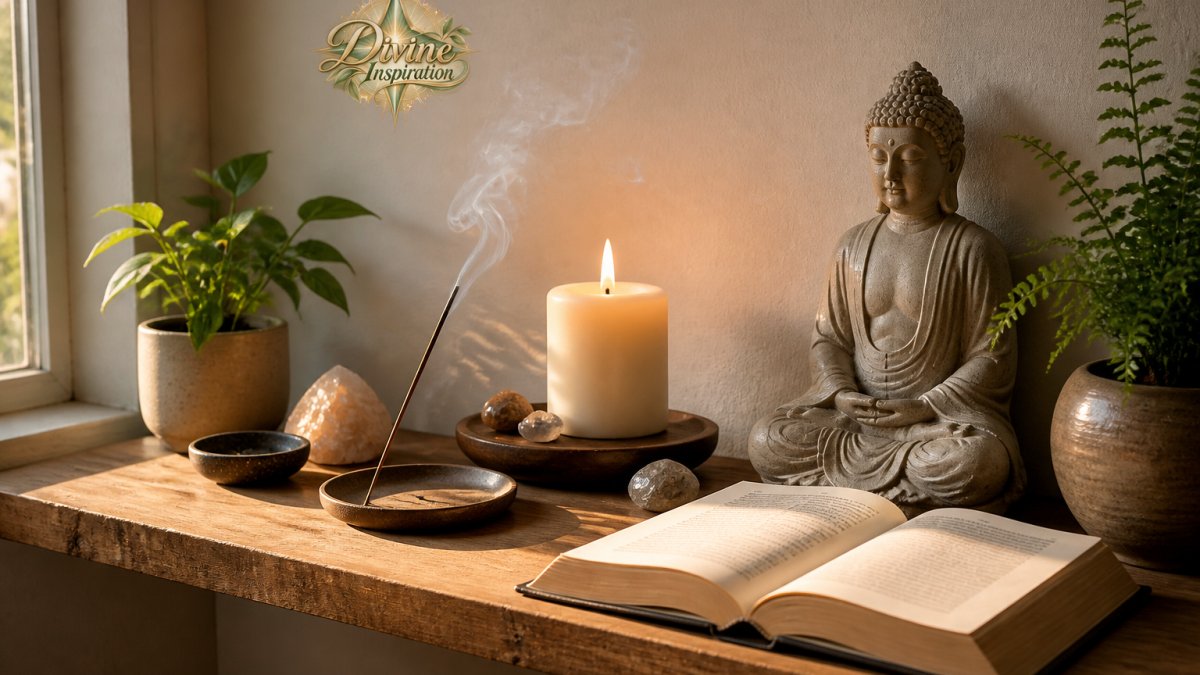
- A small table or shelf (12-18 inches wide is plenty)
- A cloth or mat to define the space
- A candle for light and focus
The cloth creates a visual boundary between your altar and the rest of the room, helping your mind shift into a different mode when you approach it. Choose a color that feels right, earth tones, white, or jewel tones all work well.
The surface should feel stable and intentional. You're creating a designated sacred space that says: "This corner of my home is different. This is where I meet myself and my faith."
What to Put on a Personal Altar: Meaningful Objects and Spiritual Tools
The items you choose should reflect your personal spiritual path. There's no single right way, what matters is that each object has meaning to you.
Common items people include:
- Candles, Light symbolizes hope, clarity, and presence. A candle gives you something to focus on during prayer or meditation.
- Incense or an incense holder, Smoke rises and carries intention. The scent helps create a distinct sensory experience.
- A statue or figurine, This might be a Buddha, an angel, a saint, or any image that represents spiritual qualities you want to cultivate.
Start with just two or three items. An overcrowded altar becomes visually distracting rather than calming. Each object should earn its place by drawing you deeper into practice.
We recommend the We Are One Alter Candle: Embrace Serenity with Every Burn, which burns for 50-60 hours with a clean, steady flame. For incense, the Enhance Your Serenity with a Traditional Wood Incense Holder provides a simple, elegant way to incorporate scent into your practice. And for a meaningful focal object, the Serene 8-Inch Buddha Statue for Protection serves as a grounding reminder of inner peace and stability.


Read more about Meaningful Objects For Sacred Spaces to explore additional options that align with your personal path.
Personal Altar Ideas for Different Spiritual Paths and Budgets
Your altar should reflect who you are and what you believe.
For a Christian altar:
- Open Bible or devotional text
- Cross or crucifix
- Prayer candle
- Image of Jesus or a saint
For a meditation or mindfulness altar:
- Buddha statue or image
- Incense or essential oil diffuser
- Meditation cushion nearby
- Crystals or stones
For a nature-based or eclectic altar:
- Stones, shells, or natural objects
- Candles
- Dried flowers or herbs
- A journal
Budget considerations:
We Are One Alter Candle: Embrace Serenity with Every Burn →
If you're starting small, you can build an altar for under $25.
The budget doesn't determine the power of your practice. A $200 altar and a $20 altar work equally well if you show up consistently and engage with intention.
Altars vary widely depending on your spiritual tradition and financial resources.
| Spiritual Path | Key Items | Budget Range |
|---|---|---|
| Christian | Bible, cross, prayer candle, saint image | Under $25 |
| Meditation or mindfulness | Buddha statue, incense, crystals, bell | Under $25 |
| Nature-based or eclectic | Stones, shells, candles, dried flowers | Under $25 |
| Any tradition with investment | Handmade candle, carved statue, quality cloth | $200+ possible |
How to Create a Prayer Altar at Home and Build Daily Consistency
Creating a prayer altar is one thing; using it consistently is another.
Step 1: Set a specific time. Choose one time each day when you'll use your altar.
Step 2: Start small. Plan for 10-15 minutes initially. This is realistic and sustainable.
Step 3: Create a simple routine. Your routine might look like this:
- Light your candle (1 minute)
- Sit quietly and settle your mind (2-3 minutes)
- Read a passage or prayer (5 minutes)
- Sit in silence or meditate (5 minutes)
- Close with gratitude or intention (1-2 minutes)
Step 4: Remove barriers. Prepare the night before. Place your book open to the right page.
Step 5: Track your progress. Keep a simple tally on a calendar.
According to research on habit formation from the University of Pennsylvania, consistent daily practice typically requires 21-66 days to become automatic.
Developing Your Daily Altar Practice and Maintaining Spiritual Discipline
Consistency is harder than setup. Most people build an altar with enthusiasm, use it for a week, then drift away. Here's how to maintain spiritual discipline over months and years, including what to do when the routine breaks.
A realistic weekly rhythm:
You do not need a long session every day. A common pattern is a short daily practice plus one longer weekly session:
- Daily (5-10 minutes): light a candle, read one short passage, sit in silence for two minutes, close with a brief prayer or intention.
- Weekly (20-30 minutes): a longer reading, journaling, or extended prayer, ideally on the same day each week.
- Monthly (optional): refresh the altar, review what you noticed, and adjust one thing.
Troubleshooting missed days and interruptions:
- You missed a day. Do not add a penalty session. Resume at the next scheduled time. A missed day is data, not failure; it usually means the time slot or length needs adjusting.
- You missed a week. Restart with the shortest version: light the candle, sit for two minutes, and stop. Rebuilding the cue matters more than the duration.
- Your schedule changed. Move the practice to the new anchor point, such as right after breakfast or right before bed.
- You were interrupted mid-session. Pause, close with one sentence of gratitude, and return later if possible. A partial session still counts.
A restart plan after a long gap:
- Pick one time this week and put it on your calendar.
- Set out only the candle and one book the night before.
- Sit for five minutes. Do not aim for more.
- Mark the day on a calendar.
- Repeat twice more before adding anything new.
Ways to deepen your practice:
- Rotate your objects seasonally
- Add a journaling component and write what you notice
- Join a prayer group or spiritual community for accountability
- Read books that challenge and inspire you
Read How to Deepen Your Inner Connection: A Practical Guide for more structured approaches to building a consistent spiritual life.
Setting Up Your First Altar This Week
You can build your first altar today. Here's a realistic timeline:
This week:
- Choose your location and test it
- Find or designate a surface
- Gather two to three meaningful objects
- Arrange them in a way that feels right
Next week:
- Light your candle for the first time
- Sit with your altar for 10 minutes
- Notice how it feels
The following weeks:
- Show up at the same time each day
- Adjust your routine based on what works
- Add or change objects as you feel called
You don't need permission or special training to start, just intention, a quiet corner, and a commitment to show up.
The right objects, a quality candle, a meaningful statue, an incense holder, can anchor your practice and deepen your connection. But the real power comes from you.
Start this week. Choose your space. Light a candle. Sit in silence. Notice what shifts.
Frequently Asked Questions
What is the difference between a personal altar and a devotional practice?
A personal altar is the physical space, the table, shelf, or corner where you place meaningful objects like candles, statues, or scriptures. Your daily altar practice is what you do there: prayer, meditation, Bible reading, or reflection. The altar is the container; the practice is the spiritual work inside it. Both together create a consistent, intentional connection with your faith.
What should you put on a personal altar if you're just starting out?
Start simple: a candle, one meaningful object (like a statue or crystal), and a sacred text if that resonates with you. The We Are One Alter Candle ($18.98) is a clean-burning soy option that creates a calming atmosphere. Add items gradually as your practice deepens. Your altar should feel personal, not cluttered. Quality and intention matter more than quantity.
How do I maintain consistency with my daily altar practice if I keep forgetting?
Anchor your altar time to an existing habit: right after morning coffee, before bed, or during your lunch break. Set a phone reminder for the first two weeks. Start with just 5-10 minutes. Place your altar somewhere you naturally pass through daily, not hidden away. Many people find that a dedicated space makes the practice feel real and easier to remember.
Can I create a personal altar in a small apartment or shared space?
Yes. Use a small shelf, corner of a nightstand, or even a window sill. A 2-by-2-foot space is enough. Choose items that stack or fit vertically. If you share your home, you can set up a portable altar in a box that closes, keep it private and accessible. Your altar doesn't need to be large to be powerful; intention and consistency matter most.
Building a personal altar is one of the most practical ways to integrate spirituality into your daily life. The physical space becomes a mirror for your inner commitment. When you show up consistently at your altar, you're building a relationship with your faith, your intuition, and yourself. Begin with Divine Inspiration's thoughtfully curated tools, quality candles, incense holders, and meaningful objects, and let your practice deepen naturally through daily presence.

0 comments