

Table of Contents
- What Makes an Object Sacred?
- Sacred Objects Examples Across Spiritual Traditions
- Objects for a Home Altar: Choosing What Belongs
- How to Create a Sacred Space at Home
- Personal Altar Ideas: Reflecting Your Spiritual Path
- Care, Handling, and Respectful Display
- Meaningful Objects Without Buying New
- Frequently Asked Questions
Last Updated: October 5, 2026
What Makes an Object Sacred?
An object becomes sacred when it holds spiritual significance for you, when it connects you to something larger than yourself. This might be a religious symbol passed down through your family, a stone you found during a meaningful moment, or an image that reminds you of your values.
At Divine Inspiration, we understand that meaningful objects for sacred spaces serve as anchors for your inner work. They're not decorations. They're reminders. A crucifix on your wall, a Buddha statue on your shelf, or a photograph of someone you love can all function as gateways to contemplation.

Many people hesitate to claim something as sacred. They worry it's not "religious enough" or not "spiritual enough." The truth is simpler: if an object draws you inward and helps you connect to your values, your faith, or your sense of peace, it belongs in your sacred space.
The best meaningful objects for sacred spaces share one quality. They interrupt your day. They make you pause.
Sacred Objects Examples Across Spiritual Traditions
Different traditions use different objects to support spiritual practice. Understanding these can help you recognize what resonates with your own path.
Christian Symbols and Devotional Items
Christian sacred objects carry centuries of meaning. A crucifix represents Christ's sacrifice and redemption. A rosary guides prayer through its beads. A Bible sits at the center of faith practice. Holy water fonts remind you of baptism and purification.
These objects work because they're tied to specific practices. When you hold a rosary, you know what to do, you pray. When you see a crucifix, you're invited into contemplation of sacrifice and love. When you light a candle before your Bible, you're creating a ritual space.
The Christ Consciousness Canvas from Divine Inspiration serves this same function. It reminds you that the sacred presence isn't distant or abstract, it's available within you, right now. For Christians and spiritual explorers alike, it becomes a visual anchor for the belief that we're all connected to the divine.

Other Christian devotional items include:
- Saint statues and figurines
- Religious artwork and icons
- Prayer books and journals
- Reliquaries holding sacred relics
- Incense for ritual and cleansing
Objects with Personal or Spiritual Meaning
Not all sacred objects come from religious tradition. Some are personal. A feather you found. A photograph. A gift from someone you love. A journal where you've recorded your spiritual insights. These objects are sacred because you've decided they are.
Personal meaningful objects for sacred spaces often carry memory. They anchor you to a moment when you felt connected, seen, or loved. A mask you wore during a transformative experience. A stone from a place where you felt peace. A letter from a friend who believed in you when you didn't believe in yourself.
The power of these objects is that they're uniquely yours. No one else has to understand why that feather matters. No one else has to approve of your journal as a spiritual tool. You do. That's enough.
Many people keep these objects on a shelf, in a drawer, or on an altar. Others carry them. The location matters less than the intention. What matters is that you encounter them regularly and that they pull you toward reflection.
Objects for a Home Altar: Choosing What Belongs
A home altar is a dedicated space for your spiritual practice. It doesn't have to be large. It doesn't have to be expensive. It has to be intentional.
Start by choosing a location. This might be a shelf, a small table, a corner of your bedroom, or even a windowsill.
Next, choose your anchor object. This is the piece that defines your altar's purpose. It might be a statue like the Serene 8-Inch Buddha Statue for Protection, which invites spiritual calm and grounding.
Then add supporting objects. These might include:
- A candle for ritual and light
- A photograph or image
- A stone or natural element
- A book or journal
- Incense or dried herbs
- A small bell or chime
- A cup for water or tea
The key is restraint. A cluttered altar becomes background noise. A simple altar invites attention. Choose 3-7 objects maximum.
The We Are One Alter Candle works beautifully on any altar. It burns for 50-60 hours, making it practical for daily ritual.

Arrange objects with intention. Place taller items in the back and shorter ones in front, so each is visible. Face objects toward you, not away. Leave space, empty space is part of the design.
How to Create a Sacred Space at Home
A sacred space is more than an altar. It's an entire area dedicated to your spiritual practice and contemplation. It might be a meditation corner, a prayer room, or simply a chair by a window where you sit each morning.
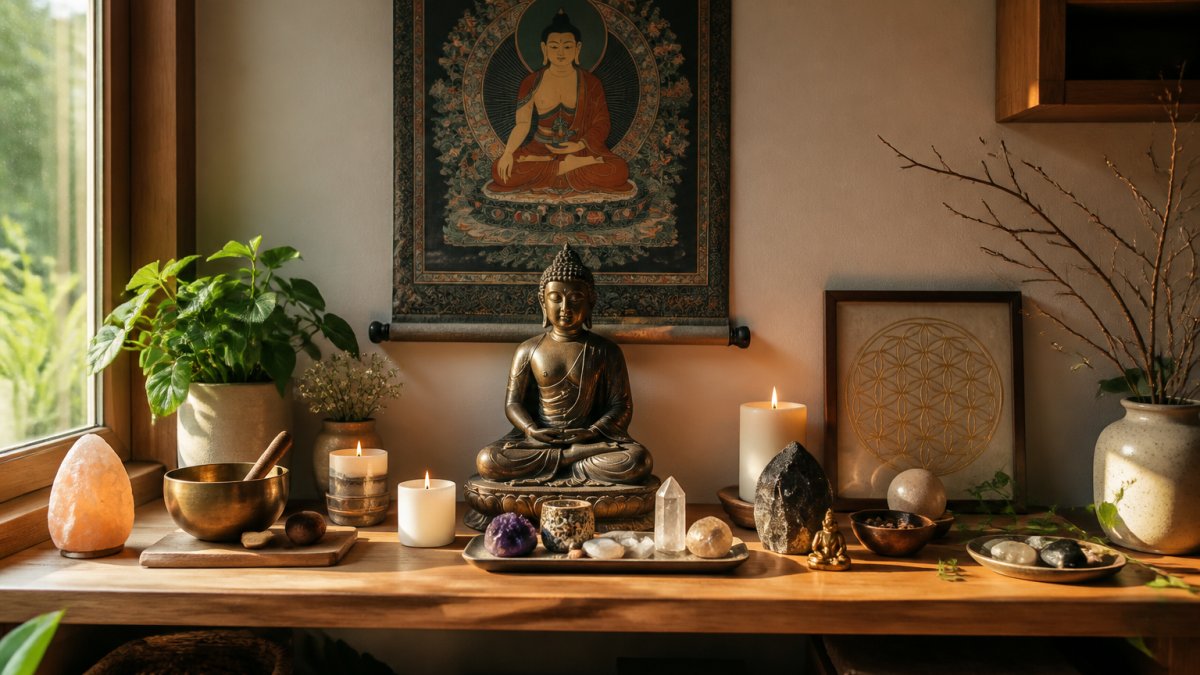
Designing for Meditation and Contemplation
Your space should invite inward focus. This means minimizing external distractions. Close the door if you have one. Silence your phone. Dim the lights or open the curtains to natural light, whatever helps you turn your attention inward.
Consider the sensory environment. What do you see? Clutter pulls your attention outward. Calm, simple surroundings pull it inward. What do you hear? Silence is ideal, but soft music or nature sounds can work. What do you smell? Incense, candles, or fresh air all anchor your practice. What do you feel?
The Christ Consciousness Canvas creates a powerful focal point for meditation. Its message of unity and interconnection supports contemplative practice. When your mind wanders, and it will, your eyes can return to the canvas, and your practice can begin again.
Light is crucial. Natural light from a window is ideal. If that's not possible, soft artificial light works. Avoid harsh overhead lights. They create tension rather than calm. A lamp with a warm bulb or a few candles create a contemplative atmosphere.
Making Space Work in Small or Shared Homes
Not everyone has a dedicated room. Many people live in small spaces or share their homes with others. You can still create a meaningful sacred space.
A corner works. A single shelf works. Even a small table works. The size doesn't matter. The intention does. If you share your home, you might:
Serene 8-Inch Buddha Statue for Protection – Embrace Spiritual Calm →
- Use a closet or under-bed storage for your objects when not in use
- Create a portable altar in a basket or box
- Designate a specific chair or cushion as your sacred spot
- Use a folding screen to create privacy
- Keep your objects in a drawer and arrange them each time you practice
The point is that you're carving out space, even temporary space, for your spiritual work. This teaches your mind that this time and place are different. This is where you turn inward.
Many people in shared homes use the We Are One Alter Candle as their primary anchor. Light it, and the space transforms. The fragrance and flame create a sensory boundary that says "this is my time." When you blow it out, you return to shared life. The candle marks the transition.
Personal Altar Ideas: Reflecting Your Spiritual Path
Your altar should reflect who you are and what you believe. Here are some approaches:
The Devotional Altar centers on religious symbols. A crucifix, religious artwork, prayer beads, and a Bible create a space for faith practice. Light a candle before prayer. Sit in silence. Let the objects guide your practice.
The Nature Altar features stones, shells, feathers, plants, and natural elements. These objects connect you to the earth and the cycles of life. Add a candle or water. Sit with the objects and notice what they teach you.
The Memorial Altar honors people or moments. Photographs, letters, and meaningful gifts create a space to remember and grieve or celebrate. This altar might be temporary, created for a specific anniversary or loss.
The Abundance Altar focuses on gratitude and intention. Include objects that represent what you're grateful for and what you're calling into your life.
The Eclectic Altar combines elements from different traditions. A Buddha statue sits beside a crucifix. A feather rests near a prayer book. This approach honors the truth that wisdom comes from many sources and that your spiritual path is uniquely yours.
The key is authenticity. Your altar should make you feel at home, not like you're performing spirituality for someone else. Include objects that genuinely matter to you. Exclude objects that feel obligatory.
Care, Handling, and Respectful Display
Sacred objects deserve care. This isn't superstition, it's respect.
Dust your objects regularly. Handle them gently. If a statue or figurine is fragile, place it where it won't be knocked over. If you have children or pets, consider their safety.
For religious objects like crucifixes or rosaries, handle them with intention. Don't toss them carelessly. Store them in a safe place. If you use them for prayer, your hands are already respectful.
Natural objects like stones or feathers benefit from occasional cleansing. Some people rinse them under water. Others leave them in sunlight. This isn't required, but it can deepen your connection to the object.
If an object breaks or wears out, thank it for its service. You might bury it, burn it, or donate it. Don't throw sacred objects in the trash. This honors the role they've played in your practice.
Candles like the We Are One Alter Candle should be burned safely. Keep the wick trimmed to prevent excessive smoking. Never leave a burning candle unattended. Place it on a heat-safe surface away from drafts, curtains, and flammable materials.
Meaningful Objects Without Buying New
You don't need to purchase new items to create a sacred space. Many meaningful objects for sacred spaces already exist in your home.
Look around. What objects already matter to you? A photograph. A book. A gift. A piece of jewelry.
Consider what's in nature. A stone from a place you love. A branch from a tree. A shell from a beach. Leaves. Flowers.
Write your own objects. A journal where you record prayers, insights, or gratitude. A letter to yourself about what you believe.
Borrow from your past. An object from your childhood. Something a loved one gave you. A ticket stub from a meaningful event.
Create art. Draw, paint, or collage something that represents your spiritual path. Frame it.
Creating a sacred space is an act of self-care and spiritual commitment. It says to yourself: this matters. I matter.
At Divine Inspiration, we believe that your sacred space should reflect your unique spiritual path.
Frequently Asked Questions
Can you give me some examples of sacred objects?
Sacred objects span many traditions. Crucifixes and crosses represent faith and redemption in Christianity. Rosaries and prayer beads support meditative practice across religions. Statues and figurines like Buddha statues symbolize spiritual qualities such as peace and protection. Icons, relics, and holy water fonts hold devotional significance. Personal items, a photograph of a loved one, a meaningful keepsake, a feather from nature, become sacred when they reflect your spiritual journey and invite inward focus and contemplation.
What should I put in a sacred space at home?
Choose objects that support your spiritual practice and reflect your beliefs. Include a focal point, a statue, canvas, or religious symbol. Add functional items like candles or a journal for reflection. Incorporate items with personal meaning: photographs, heirlooms, or gifts that represent your values of love, courage, and faith. Arrange them to create an environment for meditation and worship. The We Are One Alter Candle and Christ Consciousness Canvas from Divine Inspiration are designed specifically to anchor a sacred space with intention and beauty.
How do I choose meaningful objects for a personal altar?
Start by reflecting on your spiritual path and what draws you inward. Ask yourself: What symbols represent my beliefs? What objects remind me of my values? What items support my meditation or prayer practice? Choose quality pieces that will last. Select objects that speak to your soul, not what trends suggest. Your altar should feel authentic to your journey, whether you follow Christ Consciousness, multiple traditions, or a personal spiritual path.
Can everyday objects become sacred?
Yes. An object becomes sacred through intention and meaning. A simple stone, a journal, a photograph, or a gift from a loved one transforms into a devotional item when you place it with purpose and return to it during meditation or prayer. Sacred spaces thrive on objects that carry personal significance and invite contemplation. The act of choosing, arranging, and honoring everyday items with spiritual awareness turns them into spiritual artifacts that support your practice and reflect the sacred presence within your home.
0 comments