

Table of Contents
- Why Spiritual Tools Work When Willpower Doesn't
- 1. Meditation Cushions for Home Practice: The Foundation of a Sitting Habit
- 2. Mala Beads and Repetitive Prayer for Nervous System Regulation
- 3. Faith-Based Stress Management Techniques for Anxious Days
- 4. Journaling, Gratitude, and Inspirational Literature
- 5. How to Create a Sacred Space at Home (Even in a Small Apartment)
- 6. Matching Spiritual Tools to Your Stress Pattern
- Conclusion
- Frequently Asked Questions
Last Updated: September 16, 2026
Why Spiritual Tools Work When Willpower Doesn't
Most people managing daily stress rely on willpower alone, a limited resource that depletes under pressure. Spiritual tools to reduce daily stress work differently: they lower the effort required to stay calm by giving your body and mind an external anchor. This guide from Divine Inspiration covers seven practices, from meditation cushions to mala beads, that turn stress relief into something repeatable instead of something you force.

1. Meditation Cushions for Home Practice: The Foundation of a Sitting Habit
The best meditation cushion for home practice is a firm, supportive seat that lets you sit upright without strain, and a buckwheat-filled zafu is the standard for good reason. Buckwheat hulls mold to your body and hold their shape, unlike foam that compresses over time.
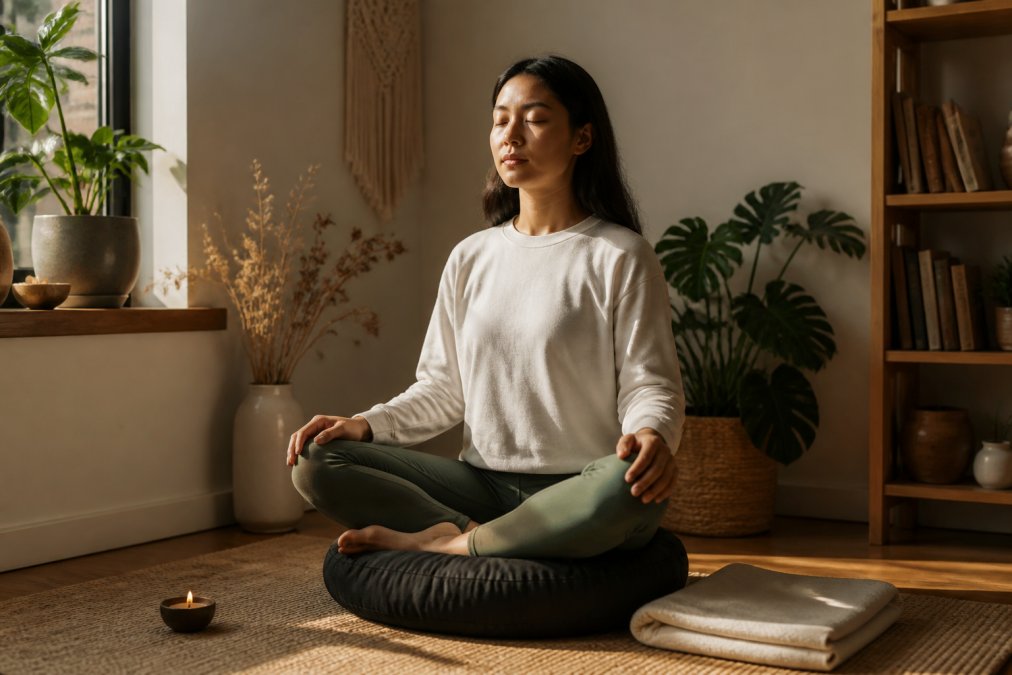
What to Look For in a Cushion
- Firm fill: Buckwheat hulls hold their shape and adjust to your sit bones; foam flattens within months.
- Removable, washable cover: Daily practice means daily contact. An organic cotton cover you can wash keeps the cushion usable.
- Height that fits you: A cushion that is too low tilts your pelvis back; too high and your knees float above your hips.
- A grip surface: If you sit on a mat underneath, a non-slip base keeps the cushion from sliding mid-session.
2. Mala Beads and Repetitive Prayer for Nervous System Regulation
Mala beads work because repetition regulates the nervous system. A traditional mala holds 108 beads, and moving one bead per breath or prayer gives your attention a physical task: repetitive motion plus slow breathing signals safety to the body. Rosary prayer, mantra repetition, and mala counting all share that structure, a fixed phrase paired with a steady rhythm, and the phrase matters less than the cadence.

3. Faith-Based Stress Management Techniques for Anxious Days
Faith-based stress management techniques reduce anxiety by shifting attention from what you cannot control to what you trust. Prayer, scripture reading, and surrender practices give anxious thoughts somewhere to go, not magic, not denial, but a deliberate redirection of attention toward a stable reference point, repeated often enough that the nervous system starts to expect it.
If You Are Spiritual but Not Religious
You do not need a formal faith tradition to use faith-shaped tools, the structure does the work, and it is portable. Three secular versions:
- A fixed phrase, repeated. Choose one sentence you actually believe, "This feeling is temporary," "I have survived this before," "I am allowed to rest", and repeat it on a slow breath for two to five minutes. This is functionally identical to mantra repetition and produces the same calming cadence.
- A surrender ritual. Write down the worry on a slip of paper, fold it, and place it somewhere out of reach until tomorrow. The physical act of setting it down gives the mind permission to stop rehearsing it.
- A reading practice. Choose a passage from any contemplative text, Stoic, Buddhist, humanist, or literary, and read it slowly once a day. The repetition, not the doctrine, is what steadies attention.
Pairing Faith Practices With Professional Care
Spiritual tools and clinical treatment are not competing systems; they work best together. A licensed therapist can address thought patterns, trauma, and physiology in ways a prayer practice cannot, and a prayer practice offers meaning a clinical framework is not designed to provide. If you are in therapy, tell your clinician what spiritual practices you use so they can flag anything making symptoms worse, for example, a scrupulosity pattern where prayer becomes compulsive rather than calming.
4. Journaling, Gratitude, and Inspirational Literature
Journaling reduces stress by moving looping thoughts out of your head and onto paper, where they become concrete and finite. Gratitude practice and inspirational reading do the same: they redirect attention toward what is steady rather than threatening. A guided journal removes the blank-page problem, Divine Inspiration's Notes to Mindfulness Journal, created with Intelligent Change and Chelsea Kauai, is built around inner peace, creative self-expression, and gratitude practice, so you are not inventing a structure from scratch.

5. How to Create a Sacred Space at Home (Even in a Small Apartment)
Creating a sacred space at home means designating one small area, even a single shelf or corner, and using it only for reflection. It does not need to be large; it needs to be consistent. Scent and sound do most of the work: a candle or incense stick signals that practice is starting, which shortens settling time. Divine Inspiration's Scent of Nirvana candle blends Oudh and agarwood, and the Egyptian Goddess incense sticks, with warm musk and floral notes, are both designed for exactly this kind of ritual cue.
Scent, Sound, and Somatic Grounding
Somatic grounding means using physical sensation to bring attention back to the body: a weighted throw across your lap, the warmth of a mug in your hands, or the pressure of your feet on the floor. Divine Inspiration's hand-loomed Nadi cotton throw is designed for a meditation corner, and the earth-touching mudra of the 8-inch Buddha in Red statue offers a visual anchor.
Buckwheat Meditation Cushion →
6. Matching Spiritual Tools to Your Stress Pattern
Different stress patterns respond to different tools, so the fastest way to build a practice that sticks is to match the tool to the symptom. Use the table below to find your starting point.
| Your Stress Pattern | Best-Fit Tool | Why It Works | Time Needed |
|---|---|---|---|
| Restless body, can't sit still | Mala beads or walking prayer | Gives hands and feet a repetitive task | 5-10 min |
| Racing thoughts at night | Guided journal | Moves looping thoughts onto paper | 5 min |
| Tight chest, shallow breathing | Cushion plus breath counting | Upright posture opens the diaphragm | 10 min |
| Overwhelmed, scattered focus | Sacred space with scent | A consistent cue shortens settling time | 3-5 min |
| Low mood, disconnection | Inspirational reading | Reframes attention toward what is steady | 15 min |
| Doomscrolling, screen fatigue | Digital sabbath plus a grounding walk | Breaks the attention loop and re-anchors to physical sensation | 20-30 min |
| Tension held in the body | Somatic practice (see below) | Releases stored muscular holding the mind cannot talk away | 5-15 min |
Somatic Spiritual Practices for Stress Held in the Body
Most spiritual stress tools are cognitive, you sit, you breathe, you think differently. That works until it doesn't, especially for people whose stress lives in their shoulders, jaw, or gut. Somatic practices use physical movement and sensation as the spiritual anchor instead of thought.
- Walking meditation. Walk slowly, at roughly half your normal pace, and place your attention on the contact between each foot and the ground. Ten minutes is enough, and it requires no equipment.
- Mudras. Hand gestures held during breathing or meditation give the body a small, specific task. The earth-touching mudra, right hand resting over the knee, fingers pointing down, is a common grounding gesture and pairs well with a seated practice.
- Yoga or gentle stretching as practice, not exercise. If you are moving to hit a target, it is a workout; if you are moving to notice sensation, it is a spiritual practice, and the stress response drops either way.
- Weighted contact. A weighted blanket, a heavy throw across the lap, or simply pressing your feet firmly into the floor all provide deep-pressure input that many people find downshifts arousal within a few minutes.
Digital-Age Spiritual Tools
The largest single source of daily stress for many people is the phone in their hand, and most spiritual tool lists ignore it. Two additions worth building into any routine:
- A digital sabbath. Choose one block of time, a morning hour, a full evening, one day a week, where notifications are off and the device is in another room. Treat it as a spiritual practice, not a productivity hack: the point is a stretch of time where nothing is asking for you.
- A grounding app used deliberately. Guided meditation and breathwork apps can be genuinely useful, but they can also become another screen to scroll. Set a timer, pick one session, and close the app when it ends. If the app is the tool, the practice is still the silence after it.
Conclusion
The hardest part of any stress practice is not learning the technique but building a routine that survives a bad week, exactly where physical tools earn their place. Divine Inspiration offers a curated collection of meaningful objects designed as physical expressions of shared beliefs, including the buckwheat meditation cushion, the Notes to Mindfulness Journal, and the Scent of Nirvana candle, each built to support a daily practice rather than sit unused on a shelf.
Frequently Asked Questions
What are some spiritual ways to reduce stress?
The most practical options are repetitive prayer or mantra, breath-focused meditation, journaling for emotional expression, and gratitude practice. Physical spiritual tools anchor these habits: a buckwheat zafu makes sitting comfortable enough to sustain ten minutes daily, a 108-bead mala gives your hands something to do while the mind settles, and a scented candle or incense stick signals to your nervous system that wind-down time has started. The tool matters less than the repetition. Pick one practice, attach it to a fixed time of day, and let the object serve as the cue.
How do I choose meditation cushions for home practice?
Start with height and fill. A buckwheat-filled zafu lifts your hips above your knees, which tilts the pelvis forward and reduces the lower back strain that makes people quit. Buckwheat also lets you shift the filling to adjust firmness, unlike foam, which flattens over time. Check the cover: a removable organic cotton cover you can wash matters if you sit daily. If you practice on a hard floor, pair the cushion with a mat underneath. A cushion that keeps you comfortable past the ten-minute mark is the one you will actually use.
Can faith-based practices improve mental well-being?
Faith-based stress management techniques work largely through the same mechanisms as secular ones: slow breathing, repeated phrases, and a sense of connection beyond yourself. Prayer and contemplative reading give structure to reflection, which is why they hold up better than vague intentions to relax. The community element matters too. People who pray or study with others report less isolation, and isolation amplifies stress. You do not need a specific denomination for this to work. What matters is that the practice feels authentic to you, so it becomes something you return to rather than something you perform.
What are the best physical objects to support a spiritual practice?
The ones you will touch every day. A meditation cushion or cork mat supports the body during sitting. A mala necklace gives you a counting rhythm for prayer or mantra. A journal captures reflection and gratitude before the thought disappears. A candle or incense stick marks the transition into practice through scent. A small statue or figurine holds your attention when focus drifts. The test is simple: if an object lives in a drawer, it is decor, not a tool. Place it where you practice, and it does the reminding for you.
How do I start a daily spiritual routine for stress reduction?
Anchor it to something you already do. Morning coffee becomes two minutes of gratitude before the first sip. Sitting down after work becomes five minutes on a cushion before you check your phone. Before bed becomes three lines in a journal. Keeping the routine under ten minutes for the first month matters more than intensity, because consistency is what produces the calm. Set up your space the night before so the cushion, candle, or journal is already in place. When the setup takes zero effort, the practice survives busy weeks.
0 comments