

Table of Contents
- What Christ Consciousness Means in Meditation
- Christ-Centered Meditation Techniques for Beginners
- How to Find Your Personal Spiritual Path
- Tools for Christ-Centered Mindfulness in Daily Practice
- Troubleshooting Common Meditation Blocks
- The Neuroscience Behind Christ Consciousness Meditation
- Integrating Christ Consciousness into Meditation: Your Next Step
- Frequently Asked Questions
Last Updated: September 28, 2026
What Christ Consciousness Means in Meditation
Christ Consciousness is the recognition of divine presence within every person, a state of unity with the sacred that meditation helps you experience directly. This guide from Divine Inspiration walks you through seven steps for integrating Christ consciousness into meditation, from your first breath prayer to handling the blocks that trip up almost every practitioner.

The idea is simple. The practice takes patience.
Many people on a spiritual journey sense there is more to meditation than stress relief. They want connection, not just calm. Christ consciousness speaks to that hunger. It points to the divine light already inside you, waiting to be noticed.
But here is what most guides get wrong: they treat Christ consciousness as a concept to understand rather than a state to practice. Reading about oneness changes nothing. Sitting in sacred silence and feeling it changes everything.
Below, we'll show you exactly how to move from theory into practice, step by step.
Christ-Centered Meditation Techniques for Beginners
Christ-centered meditation techniques are simple methods that use breath, silence, and imagery to help you feel divine presence. Two practices work best for beginners: breath prayer and heart-centered meditation on divine light. Start with one. Add the second after a few weeks.
Before you begin either practice, set up the same way every time. Consistency signals to your nervous system that sacred time has started.
- Posture: Sit upright in a chair with both feet flat, or cross-legged on a cushion. A straight spine keeps you alert; a supported back keeps you comfortable.
- Hands: Rest them in your lap or place one over your heart. Avoid gripping or fidgeting.
- Eyes: Closed, or softly open and lowered toward a candle flame.
- Timer: Set a gentle chime for five minutes. Checking a clock breaks the rhythm.
- Duration: Five minutes daily beats thirty minutes once a week. Add one minute per week until you reach twenty.
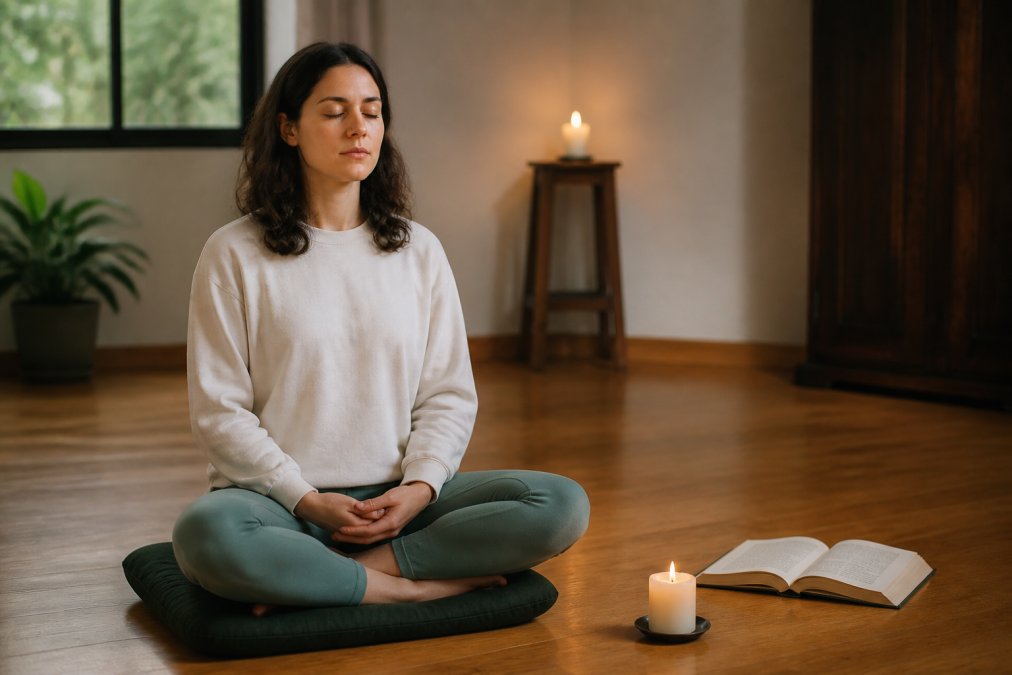
Breath Prayer and Sacred Silence
Breath prayer pairs a short sacred phrase with your breathing. Breathe in slowly. Breathe out slowly. Repeat silently. A common mistake is making the phrase too long. Keep it to a few words.
- Inhale: "Divine light"
- Exhale: "Fill me"
- Or use a single word on each breath: "Peace" in, "Peace" out
Aim for a breath cycle of about four seconds in and six seconds out.
Heart-Centered Meditation on Divine Light
Heart-centered meditation moves attention from the head to the chest. Place a hand over your heart. Picture a soft light there, warm and steady. This practice matters because it shifts you out of thinking and into feeling. Many people find this the hardest part. The mind wants to analyze. Let it settle.
Try this sequence:
- Sit comfortably and close your eyes
- Rest one hand on your heart
- Breathe normally for one minute
- Picture divine light in your chest
- Let the feeling spread outward
- Sit in that warmth for five minutes
That's it. No special equipment, no perfect conditions.
When Nothing Happens: A Beginner's Troubleshooting Guide
Most guides stop at the technique. The real question is what to do when the technique isn't working. Here are the four blocks beginners hit most, and what actually helps.
- The mind won't stop chattering. Don't try to empty it. Instead, give it one job: silently repeat your breath phrase. A mind with a task wanders less than a mind told to be blank.
- You feel nothing, no warmth, no connection. Stop chasing a feeling. Show up anyway. Spiritual depth grows in the unremarkable sessions, not the dramatic ones.
- You keep checking the time. Cover the clock and use a single chime at the end. Anticipating the bell is a habit that fades within two weeks.
- You miss a day and feel you've failed. Skip the guilt and sit for two minutes the next day. Restarting small is easier than restarting perfectly.
A Two-Week Starter Schedule
Structure removes the daily decision of what to do.
- Days 1-3: Five minutes of breath prayer only.
- Days 4-7: Five minutes of breath prayer, then two minutes of silence.
- Days 8-11: Five minutes of heart-centered meditation on divine light.
- Days 12-14: Five minutes of breath prayer followed by five minutes of heart-centered meditation.
After two weeks, keep whichever practice you looked forward to and drop the other. The one you'll actually do is the one that works.
How to Find Your Personal Spiritual Path
Finding your personal spiritual path means testing practices honestly and keeping what genuinely draws you closer to the divine. There is no single correct route. There is only the route you actually walk.
Transform Your Space with the Christ →
Ask yourself three questions:
- Does this practice make me feel more connected or more distant?
- Can I sustain it on an ordinary Tuesday, not just a retreat weekend?
- Does it make me kinder to the people around me?
Tools for Christ-Centered Mindfulness in Daily Practice
Tools for Christ-centered mindfulness are physical reminders that pull your attention back to the sacred during ordinary moments. A candle on a desk. A canvas on a wall. A book by your chair.
The point isn't decoration. It's interruption.
| Tool | Where It Fits | How It Helps Daily Practice |
|---|---|---|
| Meditation candle | Beside your cushion or chair | Marks the start of practice with a ritual |
| Wall art | Meditation space or living room | Reminds you of unity at a glance |
| Meditation guide book | Nightstand or reading chair | Gives structure when motivation dips |
| Daily lesson workbook | Desk or kitchen table | Builds a short daily habit |
Troubleshooting Common Meditation Blocks
Meditation blocks are predictable, and most have simple fixes. Knowing them in advance keeps a bad week from ending your practice.

Here are four common blocks:
- Restlessness. Your body won't settle. Fix: shorten the session to five minutes and walk first.
- Sleepiness. You doze off every time. Fix: meditate earlier in the day, sitting up, with lights on.
- Emotional flooding. Old grief or anger surfaces. Fix: let it be there without analyzing it. Shorten the session if needed.
- Feeling nothing. No warmth, no connection. Fix: stop chasing a feeling. Show up anyway.
The Neuroscience Behind Christ Consciousness Meditation
Most writing on Christ consciousness stays purely theological or esoteric. This section takes a different angle: what actually happens in the brain during contemplative practice, and why that matters for a Christ-centered meditation. The mystical and the measurable aren't enemies. Understanding the mechanism can make you a more patient practitioner.
What the Research Actually Shows
Meditation research has focused on a few consistent findings. Long-term meditators show measurable changes in brain regions tied to attention, emotional regulation, and self-referential thinking. The American Psychological Association's research on meditation has documented how regular practice affects stress response and focus, and researchers at Harvard and other universities have studied how contemplative practice alters brain structure over time.
Why This Matters for Your Practice
When you sit in stillness and feel like nothing is happening, something is happening. You are training attention and lowering reactivity. A quieter mind makes it easier to notice divine presence, which is the whole point.
A Caveat Worth Stating
Neuroscience can describe correlates, not causes. A brain scan showing gamma activity during meditation doesn't prove that meditation produces union with the divine, it shows what union looks like from the outside, in a machine. Treat the research as encouragement, not proof. The practice still has to be done by you, in silence, one breath at a time.
Integrating Christ Consciousness into Meditation: Your Next Step
The hardest part of integrating Christ Consciousness into meditation isn't learning the techniques. It's staying with them when the initial spark fades.
Frequently Asked Questions
How do I connect with Christ Consciousness during meditation?
Start by settling into a comfortable position and taking slow, deep breaths. Bring your attention to your heart center and silently repeat a phrase like 'I am one with divine love.' As thoughts arise, gently return to this phrase without judgment. The goal is not to empty your mind but to cultivate inner stillness and openness to divine presence. Consistent daily practice, even just 10 minutes, builds the capacity to recognize Christ Consciousness as an ever-present reality rather than a distant ideal.
What is the difference between traditional meditation and Christ-centered meditation?
Traditional meditation often focuses on breath awareness, body scanning, or mantra repetition for relaxation and mental clarity. Christ-centered meditation techniques add a layer of intentional connection to divine presence and spiritual transformation. You might use contemplative prayer, sacred silence, or reflection on Christ's teachings as your anchor. The structure is similar, but the purpose shifts toward mystical union and soul alignment rather than stress reduction alone. Both approaches complement each other, and many practitioners combine them.
What are the benefits of integrating Christ Consciousness into daily reflection?
Daily reflection anchored in Christ Consciousness supports spiritual awakening by helping you recognize divine awareness in ordinary moments. Practitioners often report greater inner peace, improved emotional resilience, and a stronger sense of oneness with others. It also deepens your capacity for divine love and forgiveness. Over time, this practice shifts how you respond to challenges, moving from reactivity toward heart-centered presence. The benefits accumulate gradually, so consistency matters more than intensity.
How does Christ Consciousness align with Christian mysticism?
Christian mysticism has a long tradition of contemplative prayer, sacred silence, and internal communion with the divine. Figures like Meister Eckhart and Julian of Norwich wrote about ego dissolution and mystical union in ways that parallel what many today call Christ Consciousness. This framework is not a departure from Christian tradition but a reconnection with its contemplative roots. It also resonates with universal consciousness teachings found across spiritual traditions, making it accessible to seekers from varied backgrounds.
0 comments