

Table of Contents
- Why Spiritual Decor Belongs in Your Home Office
- How to Choose Spiritual Decor for a Working Space
- Wall Art and Canvas Prints That Anchor Positive Energy
- Crystals for Office Productivity and Focus
- How to Build a Personal Altar in a Small Office Corner
- Mindful Workspace Essentials: Candles, Incense, and Journals
- Statues, Figurines, and Small Accents That Ground the Room
- Frequently Asked Questions
Last Updated: September 18, 2026
Why Spiritual Decor Belongs in Your Home Office
The best spiritual decor for home office setups marks a boundary between work's demands and the quiet center you return to.
A 2026 American Psychological Association survey found remote and hybrid workers with a dedicated, calming workspace report lower stress and better focus. You spend a third of your waking life at your desk, so treating it as sacred is maintenance, not indulgence.
How to Choose Spiritual Decor for a Working Space
Spiritual decor is any object placed intentionally to support reflection, mindfulness, or connection to something larger than your task list. In a home office, it must also survive contact with real work.
| Decor Category | Typical Price Range | Best Placement | Ritual Function |
|---|---|---|---|
| Wall art and canvas | $40-$97 | Wall behind or beside desk | Visual anchor for focus |
| Crystals and statues | $40 | Desk corner or shelf | Grounding touchpoint |
| Altar pieces | $6-$40 | Dedicated small corner | Morning and evening ritual |
| Candles and incense | $15-$58 | Desk edge, away from papers | Transition into deep work |
| Journals | $25-$35 | Drawer or desk tray | Reflection and gratitude |
Wall Art and Canvas Prints That Anchor Positive Energy
Wall art is the fastest way to change how a room feels, and the category worth spending the most on. A canvas sits at eye level all day, becoming the background of every call.
Crystals for Office Productivity and Focus
Crystals for office productivity work as attention cues, not magic. The value is the pause: you glance at the stone, remember your intention, and return to the task.
Match the stone to the job
Different stones carry different traditional associations. Pick one whose meaning matches the work you actually do at that desk.
- Grounding and steadiness. Black tourmaline, hematite, and smoky quartz are the traditional picks for people whose work involves long stretches of sustained attention. The 8" Buddha in Red ($39.95) pairs well here because its earth-touching mudra carries the same grounding association in visual form.
- Clarity and decision-making. Clear quartz and fluorite are the common choices for people who spend the day in meetings, triage, or problem-solving.
- Calm under pressure. Amethyst and lepidolite are the traditional picks for high-stakes or deadline-driven roles.
Size, weight, and the ergonomic trade-off
Crystal size is an ergonomic issue before an aesthetic one.

- Under 2 inches. Easy to knock over, easy to lose, but they fit on a monitor riser or a keyboard tray without crowding your mouse hand.
- 2 to 4 inches. The practical range for a desk corner. Heavy enough to stay put, small enough to leave your mouse path clear.
- Over 5 inches. These belong on a shelf or a side table, not the primary work surface. A large cluster near your dominant hand forces you to reach around it, and that repeated micro-adjustment erodes focus over a full day.
Care and the practical limits
Most polished stones are fine with a dry microfiber cloth. Avoid soaking porous varieties, selenite, halite, raw pyrite, since moisture degrades the surface. Keep stones out of direct afternoon sun; amethyst and rose quartz fade over months of strong UV exposure.
Place your crystal where your eyes land when you pause between tasks, not where it looks best in a photo. The cue only works if you see it without trying.
How to Build a Personal Altar in a Small Office Corner
Building a personal altar in a small office takes about 20 minutes and one square foot of surface. The goal is a fixed spot that trains attention through repetition.
- A grounding object. The 8" Buddha in Red ($39.95) or a single stone.
- A scent. The Egyptian Goddess Incense Sticks ($14.95) bring a warm musk and floral note, and the Traditional Wood Incense Holder ($5.96) keeps ash contained on natural wood.
- A written intention. A small card or a page from your journal, changed weekly.
Mindful Workspace Essentials: Candles, Incense, and Journals
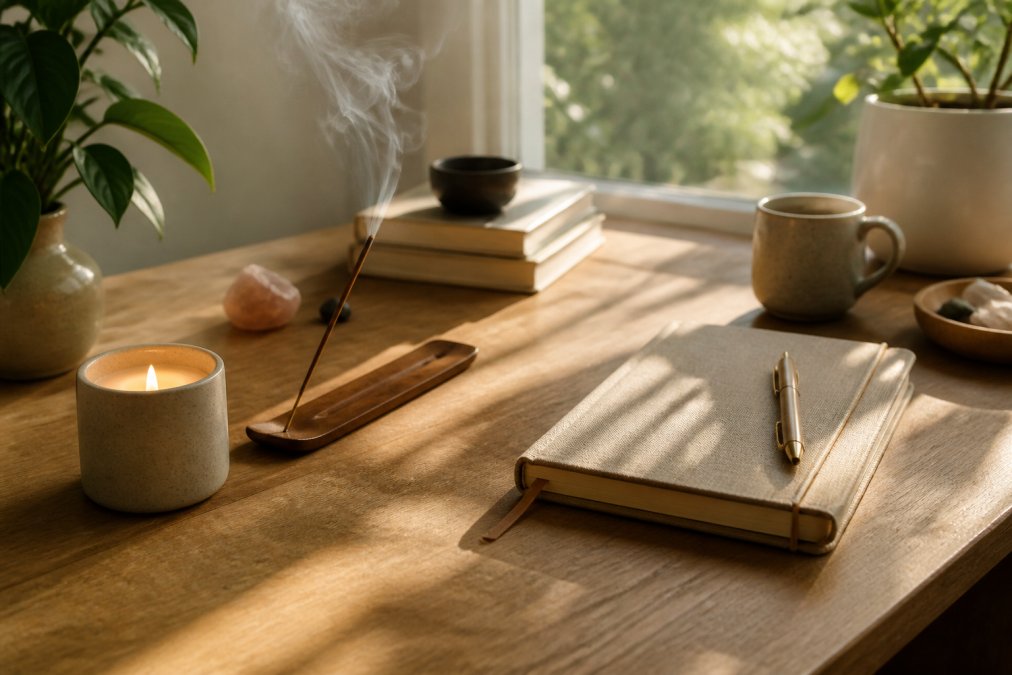
Mindful workspace essentials mark transitions: the start of focused work, the end of the day, the pause between meetings. Scent and writing do this better than anything visual.
Inspirational Spiritual Wall Art →

Statues, Figurines, and Small Accents That Ground the Room
Small accents are where most home offices go wrong. Each piece is cheap, so nobody audits the total, and within a year the desk has lost its clear surface.
Where to place accents, the spatial rules most guides skip
Placement separates a calm workspace from a cluttered one, no matter how few objects you own. Traditional Feng Shui office guidance offers concrete rules that hold up whether or not you subscribe to the philosophy:
- The command position. Place your desk so you can see the door without sitting directly in line with it, a diagonal to the doorway rather than facing a wall with your back to the room. The psychological effect is real: you stop tensing every time someone walks past behind you.
- Solid support behind you. A wall, a tall bookcase, or a high-backed chair behind your seat. An open walkway behind your chair is the single most common layout mistake in home offices carved out of living rooms.
- Keep the desk's front edge clear. The strip between you and the monitor should hold nothing taller than your keyboard. Accents go to the sides or the back corners, never the front.
- Avoid overhead beams and low shelves directly above the seat. This is the one Feng Shui rule with an obvious ergonomic basis: a low shelf over your head creates a subtle sense of pressure and limits how far back you can lean.
Blending spiritual accents with ergonomic furniture
Most spiritual decor guides treat the desk as a display surface. It is a tool, and every accent competes with your mouse path, wrist rest, monitor height, and cable routing.
A few practical integrations that work:
- Monitor riser as altar shelf. A wooden riser lifts your screen to eye level and gives you a flat surface underneath for a small statue, a stone, or a candle. Two functions, zero extra footprint.
- Desk tray as ritual zone. A shallow tray in the back corner holds your journal, pen, and one small object. It defines the ritual area visually and keeps the rest of the desk clear.
- Wall-mounted shelf above the monitor. This is where larger statues and candles belong if you want them visible during calls. It keeps the work surface free and puts the accent at eye level.
- Cable management as spiritual practice. A single cable raceway or a velcro tie bundle does more for the calm of a workspace than any object on this list. Tangled cables read as unfinished work to the eye, and the eye does not distinguish between visual noise and mental noise.
The honest trade-off
Small figurines rarely survive a move or reorganization. For one object that stays meaningful for years, buy the Buddha statue and stop there. For a setup that adapts as your work changes, invest in the spatial rules first, command position, solid support, clear front edge, and add objects second.
Frequently Asked Questions
What are some good things to put in my office to attract good luck?
Start with a grounding focal point like a Buddha statue in red robes, which traditionally signals protection and positive energy. Add a small crystal arrangement, a candle, and a piece of wall art with an uplifting message. Keep the surface uncluttered so each item can be seen and used. The goal is not superstition but a daily visual reminder that pulls your attention back to calm and intention before you start work.
How do I build a personal altar in a home office without a lot of space?
You only need a shelf, a corner of your desk, or the top of a low bookcase. Choose one anchor piece, such as a canvas print or statue, then layer two or three smaller items: an incense holder, a candle, and a journal. Keep the arrangement low so it does not block your screen or keyboard. Refresh it seasonally so the altar stays meaningful rather than becoming background clutter.
Which crystals are best for office productivity?
Crystals for office productivity usually center on focus, grounding, and clear thinking. Amethyst is a common choice for calm concentration, while selenite is used for clearing stagnant energy in a room. Place a small cluster or geode near your monitor or on a corner shelf where you will see it during the day. Pair it with a short pause, such as three slow breaths, so the crystal becomes a cue for resetting your attention.
What mindful workspace essentials should I start with?
Begin with four items: a candle or incense for scent, a journal for reflection, a piece of wall art for visual grounding, and one small object you can hold, such as a smooth stone or figurine. These cover scent, writing, sight, and touch, which are the senses most tied to routine. Add items gradually over a few weeks so each one earns its place on your desk.
How can I make my home office feel more peaceful and intentional?
Reduce visual noise first. Clear the desk, hide cables, and limit decor to a few meaningful pieces rather than many small ones. Choose neutral tones for larger surfaces and let one or two spiritual items carry the color. Add a natural element such as wood or a small plant. Position your desk so you can see the focal piece when you look up, which turns a short pause into a reset during long work sessions.
0 comments